
Losing a tooth feels significant in the moment. But what many people don’t realize is that the effects continue long after the gap appears. One of the most important things that happens after tooth loss is something you can’t see at all: your jawbone starts to shrink.
Understanding this process, and why dental implants are one of the best ways to stop it, can help you make a more informed decision about your care. At Blossom Dental Centre in High River, the team wants every patient to have the full picture before they decide how to move forward.
What Happens to Your Jawbone After Tooth Loss
Your jawbone stays strong because your teeth keep it active. Every time you bite and chew, the roots of your teeth transmit pressure down into the bone. That stimulation signals the bone to maintain its density and structure.
When a tooth is lost, that stimulation stops. The bone no longer receives the signals it needs. As a result, it begins to break down in a process called resorption. The body essentially treats the bone as no longer necessary and starts to reabsorb it.
This process begins quickly. Studies show that patients can lose up to 25 percent of bone width in the first year after an extraction. By the end of the second year, that loss can reach 40 percent or more in some areas. The bone doesn’t just become thinner. It also loses height over time, which changes the shape of your jaw and the appearance of your face.
This isn’t something most patients expect when they lose a tooth. But it’s one of the most important reasons to think carefully about replacement options and to act sooner rather than later.
How Bone Loss Accelerates Over Time
Bone resorption doesn’t happen at a steady, slow pace. It tends to be most rapid in the first few months after tooth loss, then continues at a slower rate for years afterward.
In the early weeks and months, the body reorganizes the extraction site aggressively. The outer wall of the socket, called the buccal plate, is particularly vulnerable. It can collapse significantly in just the first few months. Once this early phase passes, bone loss slows but doesn’t stop.
Over several years, the cumulative effect becomes more noticeable. The ridge of the jawbone, which once supported your tooth, flattens and narrows. Neighbouring teeth can begin to shift. The changes start to affect not just your oral health but also your facial structure, sometimes contributing to a sunken or aged appearance around the jaw and cheeks.
The longer the gap remains without a replacement, the more bone deterioration accumulates. And the more bone that deteriorates, the more complex any future tooth replacement becomes.
How Dental Implants Help Preserve Bone
Dental implants are the only tooth replacement option that directly addresses bone loss. This is what sets them apart from dentures and bridges.
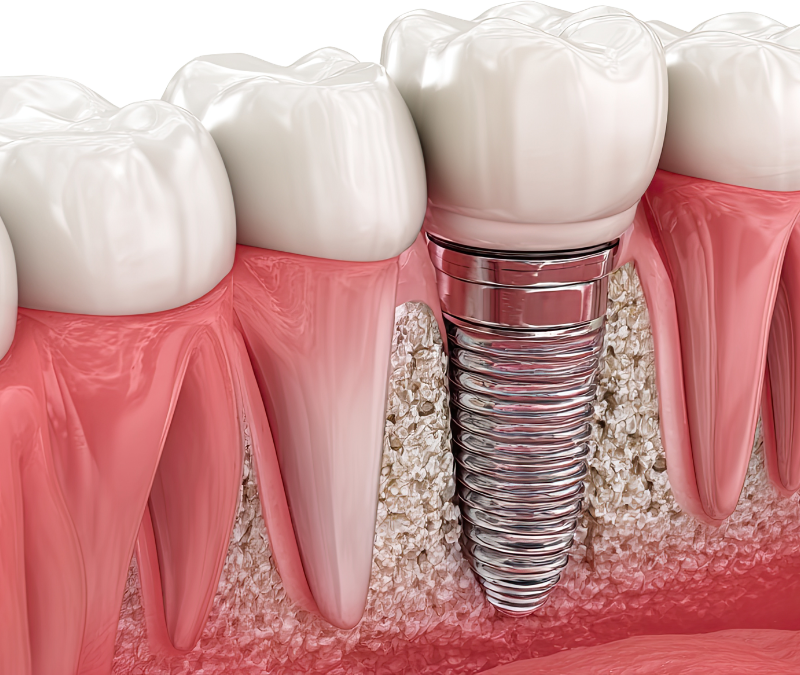
A dental implant uses a small titanium post inserted into the jawbone to replace the missing tooth root. Once in place, the post integrates with the surrounding bone through a process called osseointegration. This means the bone actually bonds to the titanium surface, treating it much like a natural root.
When you chew with an implant-supported tooth, that pressure transfers through the post and into the bone, just as it did with your natural tooth. The bone receives stimulation again. It responds by maintaining its density and structure instead of breaking down.
This is a significant benefit that dentures and bridges simply cannot provide. A bridge spans the gap but leaves the bone beneath unstimulated. Dentures rest on the gum surface and do nothing to slow resorption. Over time, bone loss continues beneath both options, which is why dentures often require relining and adjustment as the jaw changes shape.
Dental implants interrupt that cycle entirely. At Blossom Dental Centre, this bone-preserving benefit is one of the most important reasons the team discusses implants as an option for eligible patients.
How Long Can You Wait Before Bone Loss Affects Implant Candidacy?
This is one of the most common questions patients ask, and it deserves an honest answer.
There is no single universal deadline for implant placement. Some patients can still receive implants years after a tooth loss. But the longer you wait, the more likely it becomes that bone loss has progressed to a point where additional procedures are needed before implant placement can happen.
When bone density or volume falls below a certain threshold, the implant post doesn’t have enough structure to integrate properly. In these cases, a bone graft may be necessary. A bone graft rebuilds the area using bone material, either from another part of your body or from a donor or synthetic source, before the implant post can be placed.
Bone grafting is a well-established procedure and it works well for many patients. But it does add time, cost, and an additional healing period to the process. Patients who act sooner often avoid the need for grafting altogether.
As a general guide, placing an implant within a few months of extraction, after the site has had time to heal from the extraction itself, tends to preserve the most bone and simplify the overall process. Your dental team will assess your specific situation using imaging to determine exactly how much bone remains and what your options are.
What If You’ve Already Waited a Long Time?
If it has been years since you lost a tooth, don’t assume implants are off the table. Many patients who have waited are still good candidates, sometimes with the help of bone grafting. The best thing you can do is book a consultation and find out exactly where things stand.
Waiting longer doesn’t help. But it’s also never too late to ask the question.
Taking the Next Step
Bone loss after tooth loss is real, it’s progressive, and it has long-term consequences for your oral health and your appearance. Dental implants offer a way to stop that process and restore your smile with a solution that functions like a natural tooth.
The team at Blossom Dental Centre in High River is here to help you understand your options and find the path that works best for you. Every patient’s situation is different, and a proper assessment is the starting point for any good treatment plan.
Call Blossom Dental Centre at 825-212-0406 or email [email protected] to book your consultation. The clinic is located at 134C Macleod Trail SW, High River, AB, and welcomes patients Monday through Saturday, 9:00 a.m. to 5:00 p.m.
The sooner you have the conversation, the more options you’ll have. Blossom Dental Centre is ready when you are.